Multi-Channel Municipal Customer Service Transformation
A Canadian city modernized customer service across telephone, counter, email and online portal channels while connecting service intake with field operations.
Engagement at a Glance
Organization
Canadian city government
Industry
Public Sector
Solution
Customer Service Transformation, Knowledge Management, Work Management
Platforms
Cartegraph, ESRI, Salesforce, Telephony
OUTCOMES AT A GLANCE
A connected experience designed around the business need
Standardized intake across four customer-service channels
Connected customer requests with GIS and operational work management
Supported 50 service types with knowledge, migration and training
ENGAGEMENT OVERVIEW
Understanding the organization and the scope
Organization Profile
The municipality serves residents through assisted and digital channels and coordinates service delivery with operational teams using GIS and work-management systems.
Engagement Scope
Implementation management for a Salesforce customer-service solution supporting 50 service types, knowledge content, telephony automation, mapping, mobile work orders, migration, training and go-live.
THE CHALLENGE
What needed to change
The city needed one service model for requests arriving through four channels and requiring coordination with field and operational systems.
Business Challenge
Resident requests entered through telephone, service counters, email and a public portal. The city required consistent capture and handling across all four channels while supporting 50 distinct service types. Agents needed reliable knowledge, and operational teams required GIS and work-management connectivity. Historical requests and knowledge content also had to be transferred without disrupting service delivery.
Operational Impact
Disconnected channel processes could create inconsistent request information, repeated handling and limited visibility between customer-service and operational teams. Without migration and training, adoption and continuity would also be at risk.
Key Requirements
Fifty service types; phone, counter, email and portal intake; knowledge articles; telephony automation; ESRI and Cartegraph integration; legacy request and knowledge migration; mobile work orders; mapping; training; and go-live support.
THE SOLUTION
How the challenge was resolved
A Salesforce customer-service solution standardized four intake channels and connected knowledge, telephony, GIS and mobile work management.
Solution Overview
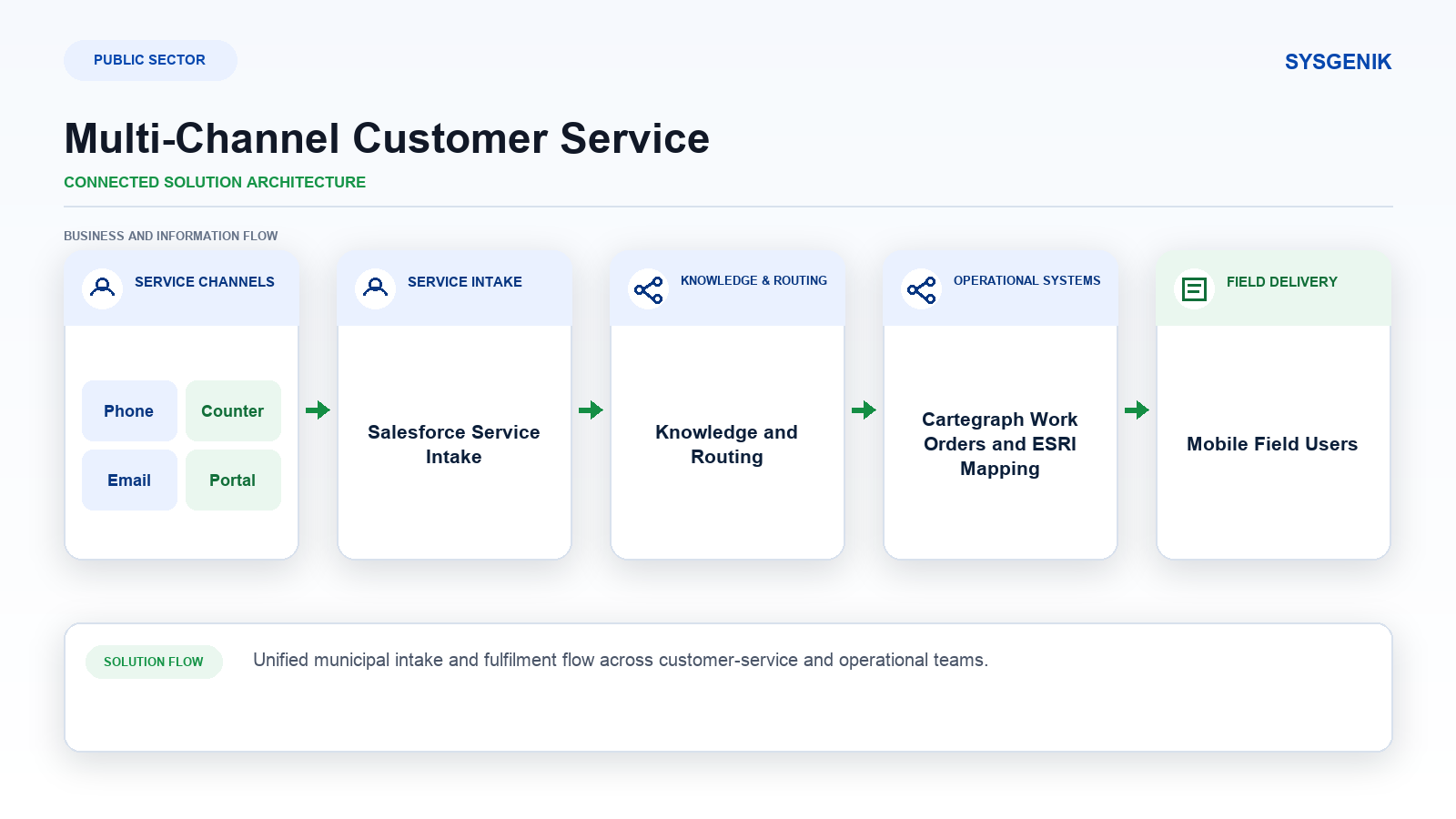
The implementation configured a common Salesforce service model for 50 municipal service types. Channel-specific intake was brought into consistent request processes. Knowledge articles supported agent responses, telephony automation assisted contact-centre handling, and ESRI and Cartegraph integrations connected service activity with location and operational work. Historical service requests and knowledge were migrated, and mobile work-order capabilities supported field personnel.
DELIVERY APPROACH
From requirements to a coordinated release
Delivery Management
Confirmed service-type requirements; coordinated channel and workflow configuration; managed integration dependencies; oversaw migration and validation; coordinated testing; prepared users through training; and supported go-live.
Process Improvements
Introduced consistent intake, classification, routing, knowledge use, work-order coordination and status tracking across assisted and digital channels.
Salesforce customer service and Knowledge, public portal capabilities, telephony automation, ESRI GIS, Cartegraph work management and mobile access.
Cartegraph, ESRI, Salesforce, Telephony
Unified municipal intake and fulfilment flow across customer-service and operational teams.
BUSINESS OUTCOMES
What the engagement enabled
The city gained a consistent service model across four channels, improved access to reusable knowledge, stronger connectivity with GIS and work management, and a structured foundation supporting 50 service types.
Planning a similar transformation?
Talk to SYSGENIK about translating complex business requirements into a practical, connected solution.